Market insight
Q4 2025 M&A: bigger deals and a heavier diligence front end
By the CogniSuite team
Bigger deals, fewer of them
Q4 2025 is where the year's largest transactions landed.
- 22 of 2025's record 70 megadeals ($10bn or more) were announced in the quarter, per Reuters, citing Dealogic data as of 16 December 2025.
- October alone topped USD 300bn across six megadeals, per Mergermarket.
- Average US deal size reached USD 400.1m between 1 October and 1 December, more than triple Q1's USD 121m, per A&O Shearman.
- Financial services shows the shape cleanly. KPMG reports Q4 value of $171.7bn, up 68.7% quarter on quarter, on volume down 3.2% to 1,240 deals, with strategic buyers behind 83.1% of it.
Two to know by name. Netflix agreed on 5 December to acquire Warner Bros. at $27.75 per share, roughly $82.7bn enterprise value, after Warner Bros. Discovery's board rejected the competing Paramount Skydance tender on 17 December, sized by Mergermarket at USD 108bn. Aligned Data Centers went on 15 October at roughly $40bn.
Why there is no global Q4 total
No public source we could verify publishes one. Every tracker reports full-year 2025 or an H1 and H2 split, and subtraction fails because those totals disagree.
- Value: $4.6tn, up 49% (LSEG); USD 4.81tn, up 41% (Mergermarket); $4.8tn, up 36% (Bain).
- Megadeal count: 70 on Dealogic and Mergermarket, 68 on LSEG, 63 through late November per Wachtell Lipton.
- Deal count direction: Reuters, on Dealogic data, reports 38,395 deals, down 6%. Bain reports count up 5%. The definitions are not public enough to reconcile.
Timing explains part of it. Bain published on 11 December, Mergermarket and Dealogic on 17 December, Reuters on 25 December using data as of 16 December, so those full-year totals are partial-year snapshots. Cite the publisher and the cutoff alongside any 2025 market figure in a pitch or a fairness opinion.
What got heavier
Financing costs and merger control both eased. The evidentiary work moved earlier, into the weeks the data room is being built.
- The FOMC cut 25 basis points to 3.50% to 3.75% on 10 December 2025, its third straight cut.
- A&O Shearman counts 16 deals prohibited or abandoned on antitrust grounds across 26 jurisdictions in 2025, down from 39 in 2024. Procedural sanctions reached $62.7m, more than double 2024.
- The expanded HSR Form demands substantially more information up front. Wachtell Lipton attributes more pre-signing information gathering to it; Morrison Foerster notes early termination was reinstated for roughly 300 deals through end-2025.
- In a survey of 150 US investment-bank executives by ION Analytics and SRS Acquiom, one in five said diligence timelines had lengthened over two years, 57% of those by one to three months. 51% called technology diligence the most burdensome element.
- Bain reports 75% of strategic acquirers assessed AI impact on the target, and at least 20% walked away over what they found.
What CogniVault does about it
It shortens the setup end, where the new pressure sits.
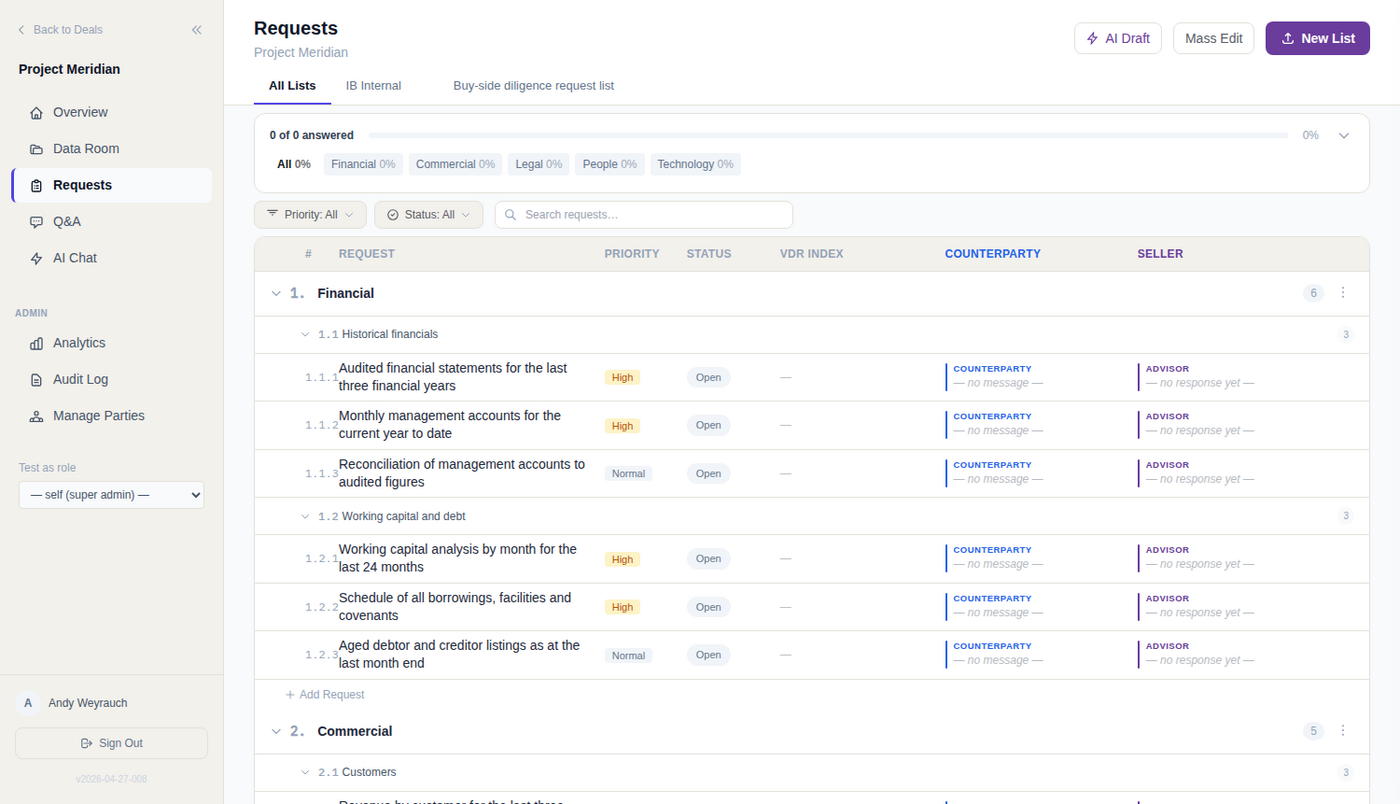
- Build the room from a description. Get a drafted request list plus matching folder tree from prose, or start from a canonical M&A structure with per-folder access tiers preset. All of it is a draft the deal team edits first.
- Import the client's Excel checklist. The model reads the spreadsheet's layout instead of transcribing its contents, so requests are not paraphrased or invented on the way in, and coverage warnings flag rows the import may have dropped.
- Match files to requests both ways. Uploads are scored against open requests and proposed as answers, and bulk actions preview before writing anything.
- Answer a duplicate once. A request duplicating one in flight is flagged, and on a banker's approval inherits the confirmed answer documents. Buyers can dispute the merge.
- Ask the room questions. Multi-turn chat over the deal's files, streamed as it is written, with open request status folded in.
- Keep the AI inside the permission model. Retrieval applies the folder-read check before admitting a document, every deal is a physically separate database, and counterparty-facing drafts are grounded only in what that side may read.
- Verify every citation. The server checks each citation against the document text before anyone sees it, and replaces claims it cannot verify with a review template.
Where the limits are
- No figure reconciliation. If two documents in the room disagree on a number, the platform will not tell you.
- One embedding per document, taken from its opening text. Retrieval points at documents, not at passages inside long ones.
- Enrichment is best effort. If extraction fails, the file is viewable but has no embedding, so chat and search miss it until it is reprocessed.
- Watermarks are visible marks, not forensic ones. PDF, Word, images, Excel and PowerPoint all carry one, and a format that cannot be marked is refused rather than served clean, but nothing survives a photograph or a retype.
- The audit log is not tamper-evident, and only the advising firm can read it.
- Sign-in is an emailed code, with OpenID Connect single sign-on for your own firm's users. Deal-room participants use the emailed code, and the platform enforces no second factor of its own.
Test these boundaries yourself, and read our security page.
General information, not legal, tax or financial advice. For how CogniVault handles security and access, see Security. To see it on a live deal, book a walkthrough.