Market insight
Q1 2026 M&A: record value on deal counts nobody agrees on
By the CogniSuite team
The trackers disagree on how big Q1 was
No single global total is verifiable. Pick one tracker and one threshold, and say which.
- PitchBook, via Yahoo Finance: about US$1.6 trillion, up 50.6%, across 13,877 deals, up 18.3%.
- Bain, on Dealogic data above $30m: value up 28%, volume up 9%.
- Mergermarket, through 23 March 2026: US$1.16 trillion, up 22%.
- FTI Consulting: volume down 4.4% quarter on quarter.
The gap is methodological. PitchBook counts very large private financings league tables treat differently; Bain excludes everything under $30m. Averaging them gives a number no dataset supports. LSEG published only a half-year US$2.85 trillion, counts down 9%.
A few very large deals carried the quarter
Concentration is the one point every dataset agrees on. Mergermarket counted 17 megadeals of US$10bn or more worth US$413bn, WTW records 12 completions above US$10bn against 2 in Q4 2025, and median EV/EBITDA reached 10.7x, the highest since 2021.
- SpaceX and xAI, a US$250bn valuation announced 3 February 2026, more than 15% of global Q1 value on PitchBook's numbers.
- Paramount Skydance and Warner Bros. Discovery, US$81bn equity, US$110bn enterprise value. The US$170bn figure in secondary write-ups contradicts the parties' release.
- McCormick and Unilever's foods business, at EUR 37.1bn per Mergermarket but US$44.8bn in PitchBook-sourced coverage. We could not resolve it.
Regionally, the Americas rose 35.6% on counts down 3.6% while APAC fell on both.
Sponsors stayed busy but lost the top end
Corporates outbid sponsors. PE was 40% of global deal count and 50% of value yet backed 1 of the 10 largest North American deals, against 4 in Q4 2025.
- Volume: KPMG has US$436.4bn across 4,168 deals, Foley & Lardner, on the same provider, 5,100 deals worth US$481.6bn. Different vintage.
- Constraint: fundraising, at a 12-month US$373bn across 549 funds, the lowest since Q1 2017.
- Mid-market: no rebound: US count down about 20% in January and February on financing costs and software valuation doubts.
Merger review got quieter, the states did not
Dechert's DAMITT report records no contested merger complaint from either US agency, and durations of 10.8 months across the four significant investigations concluded, against 12.3 in 2025. Still plan for 11 months, plus 6 to 12 more if litigated.
- The HSR threshold rose to US$133.9m effective 17 February 2026.
- The expanded 2025 HSR form was vacated on 12 February 2026 by the US District Court for the Eastern District of Texas, and the Fifth Circuit declined to stay that ruling on 19 March 2026. Filers are back on the legacy form, with less pre-filing assembly.
- State attorneys general became the challengers. Eight states sued to block Nexstar's US$6.2bn TEGNA acquisition despite FCC and DOJ approval. Federal clearance no longer ends regulatory risk.
What it means for the diligence workstream
Carve-outs are the job. KPMG's survey of 700 senior dealmakers, fielded 19 December 2025 to 27 January 2026: 56% already use AI in diligence and valuation, 71% of PE respondents are open to or pursuing separations, and the top-ranked risk is operational disentanglement at 52%. A carve-out document set is incomplete by construction, so the work sits in the request list.
CogniVault is built for that workstream:
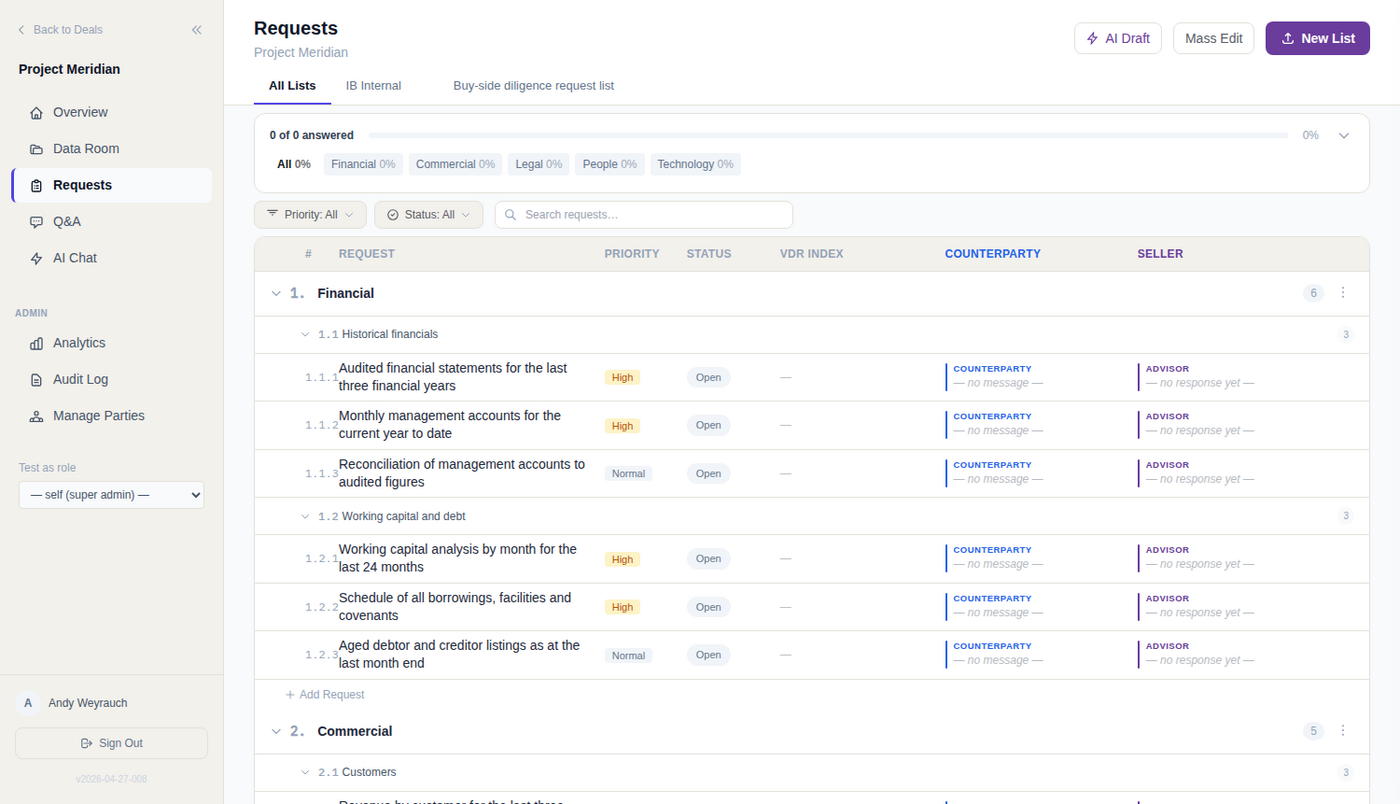
- Import the client's checklist as it arrives, in any Excel layout. The model returns a reading plan and the application reads the cells, so a request cannot be paraphrased or invented. Coverage warnings flag dropped rows.
- Uploads answer requests on their own. Every file is scored against open requests and proposed as a match, and bulk actions run a whole backlog behind a preview that writes nothing.
- Answer once. Duplicate requests are found by embedding; on banker approval, the earlier request's confirmed documents attach to the new one.
- Drafts stay inside counterparty permissions. A draft for the other side quotes only what that side may read, and every citation is verified against the source text.
- The room knows which side you act for. Buy-side or sell-side, the counterparty is kept out of the Internal room by default, with access set per folder.
What it does not do
- No figure reconciliation engine. The chat prompt asks the model to flag disagreements when both documents reach the same retrieval batch; nothing else compares figures.
- One embedding per document. Retrieval points at documents, not at passages inside them.
- No OCR. A scanned PDF with no text layer will not enrich, staying invisible to chat and matching until reprocessed.
- The audit trail is advisor-only. It is an oversight record, not a mutual one.
No reputable figure for Q1 2026 diligence duration exists either. Controls are on our security page.
General information, not legal, tax or financial advice. For how CogniVault handles security and access, see Security. To see it on a live deal, book a walkthrough.