Market insight
Q2 2025 M&A: value up, deal count at a twenty-year low
By the CogniSuite team
Why the Q2 numbers disagree
No single reconciled global figure for Q2 2025 exists. The most cited trackers measure different things:
- Mergermarket and Dealogic put first-half value at USD 2tn, up 25%, on 16,663 deals, down 16% and the lowest count since 2005 (M&A Highlights 1H25).
- PwC frames the same half as value up 15% and volume down 9% (Global M&A Industry Trends 2025 Mid-Year Outlook).
Mergermarket counts minority stakes and financings others exclude, and its 23 June cut-off leaves Q2 incomplete.
The shape is agreed: value up, count down. 33 deals topped USD 10bn in the half, the most since the second half of 2020, while the USD 200m to USD 1bn mid-market fell 3.2%.
Where tariffs show up
The 2 April tariff announcement reads as a specific April drop, not a general slowdown. Mergermarket by region:
- EMEA. April volume down 39% month on month to USD 64.2bn. Q2 sat 24% below Q1, and the half's 6,451 deals were a twelve-year low.
- North America. Also down in April, then up 46% in May to USD 207.2bn. Half-year value grew 11% to USD 969.8bn on a count down 17%, its lowest since 2009.
- Asia-Pacific. The outlier: volume up 97% to USD 572bn, Japan up 3.7 times, mainland China up 2.3 times.
Financing cost does not explain the European weakness. The ECB cut twice, to 2.00% by 11 June 2025, while the Federal Reserve held at 4.25% to 4.50% all quarter. Europe eased and its buyouts still fell, so the binding constraint was uncertainty.
Sponsors: bigger deals, shut exits
Exit value rose because a few very large assets cleared, not because the window reopened (Mergermarket):
- Buyouts. Volume up 35% to USD 359bn on a count down 7% to 1,398. Six above USD 10bn totalled USD 101bn against three worth USD 34bn a year earlier, the largest a USD 24bn consortium bid for Santos.
- Exits. Volume up 45% to USD 279bn on 613 exits, down 7%.
- IPOs. Only 19 sponsor-backed IPOs took place in the half, nine of them priced in Q2 2025 against 11 a year earlier.
- North America. Sponsor buyouts USD 83.6bn, down 14% on Q1; sponsor exits USD 92.4bn, down 12%.
Longer merger reviews
Contested deals took longer, uncontroversial ones cleared faster. Dechert's Q2 2025 tracker puts the average significant US merger investigation at 13.6 months, 20% above the 11.3-month full-year 2024 average. EU Phase I remedy cases averaged 13.8 months, about four months above the 2011 to 2022 norm.
Settlements returned at the same time. Dechert counted five consent decrees in the quarter, more than the previous nine combined, and McDermott Will & Emery notes the FTC reinstated early termination of the HSR waiting period, with 100-plus requests granted since.
What changed in diligence
Contract review moved from a sample to a population exercise. Tariff exposure does not sit in historical financials, so Mayer Brown has buyers reading supplier and customer agreements one by one to establish who bears the cost, work it calls "extremely challenging and somewhat speculative". Longer sign-to-close windows also bring the same question back from another party months later. No survey measured diligence duration in the quarter; Goodwin's timeline data covers deals only through 2022.
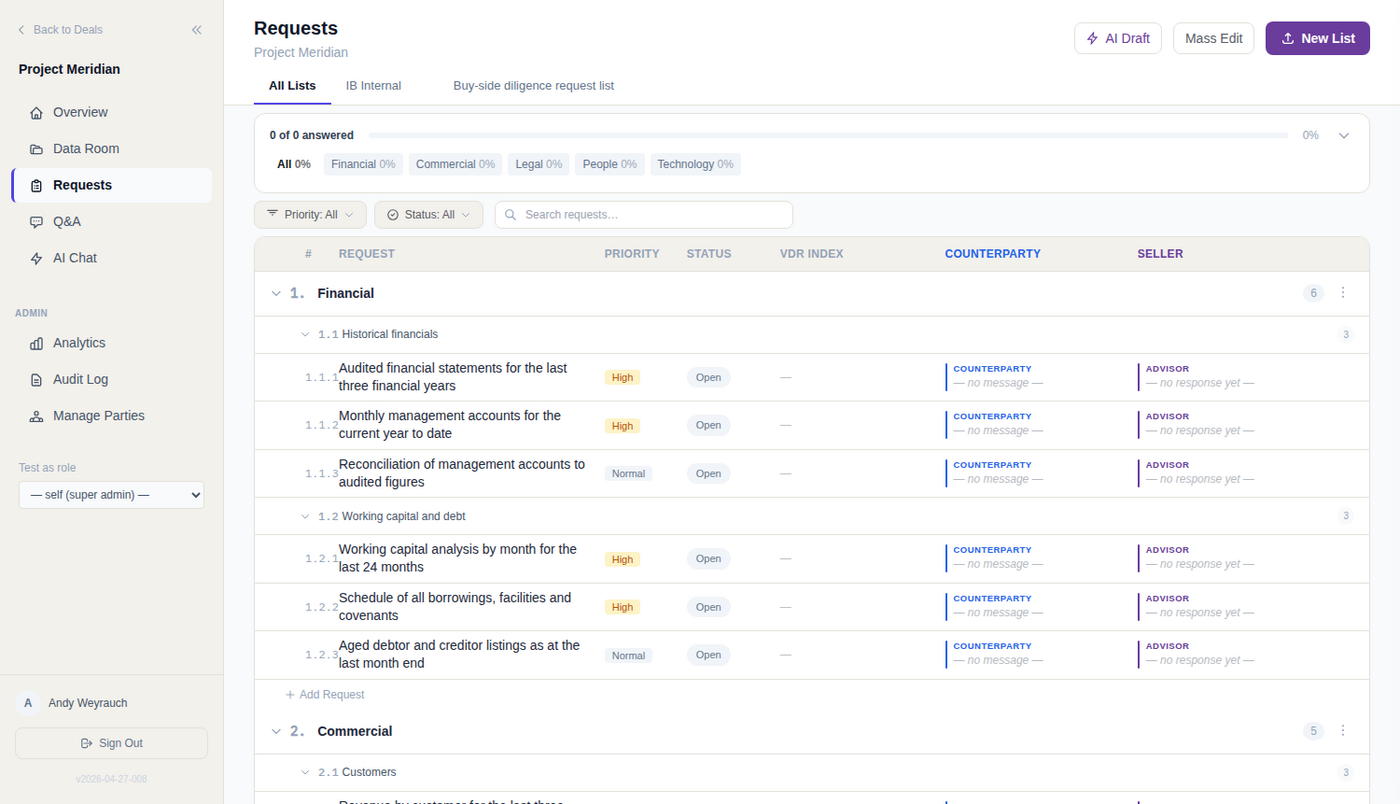
CogniVault is built for that workload:
- Import the list as sent. The model reads a client's Excel checklist and returns a reading plan, which tabs and columns mean what. The app executes it against the raw cells, so a request cannot be paraphrased or invented in transit. Coverage warnings flag dropped rows.
- Match files and requests both ways. Every upload is scored against open requests and proposed as an answer, split into confident and needs-review. Bulk runs preview before writing.
- Answer once. A new request duplicating one in flight is flagged for the deal team and, on approval, inherits the confirmed answer documents. The counterparty can dispute the merge.
- Ask the room. Multi-turn chat over deal documents, re-scoped to the asking user's folder permissions every turn.
- Verify before it leaves. Counterparty-facing drafts are checked server-side, quote by quote, against the source document. An unverifiable affirmative answer goes to manual review.
Where this stops
- No reconciliation engine. Nothing compares a figure in one document against a conflicting one in another. Flagging a disagreement rests on model instructions and on both documents landing in one retrieval batch, so it is a prompt, not a control.
- Scanned PDFs. A PDF with no text layer is not readable by the ingestion pipeline.
- One vector per document. Each file is embedded over its opening text, so retrieval points at a document, not a clause inside a long supply agreement.
Software narrows where to look. A person still reads the contract. See security for how access is scoped.
General information, not legal, tax or financial advice. For how CogniVault handles security and access, see Security. To see it on a live deal, book a walkthrough.