Product spotlight
Answer-once question matching
By the CogniSuite team
Now live in CogniVault: answer-once matching across the deal. When a new diligence request repeats one you already answered, the room spots it, and on your approval the confirmed answer and its documents carry across. Four bidders asking for the same schedule cost your team one review, not four.
What you get
- Duplicates found for you. Scan one request or a whole list. Pairs above the similarity bar queue as pending links, best first, and rescanning never stacks duplicates of duplicates.
- A person approves every merge. In full, in part with a written note on the gap, or not at all. Pending links stay invisible to buyers until reviewed.
- The documents travel with the answer. Approve in full and every confirmed source file copies across. No retyping, and no risk of a different file set going out.
- Buyers can push back. A disputed merge goes back to your team for a second look, and the objection and the decision both stay on the request.
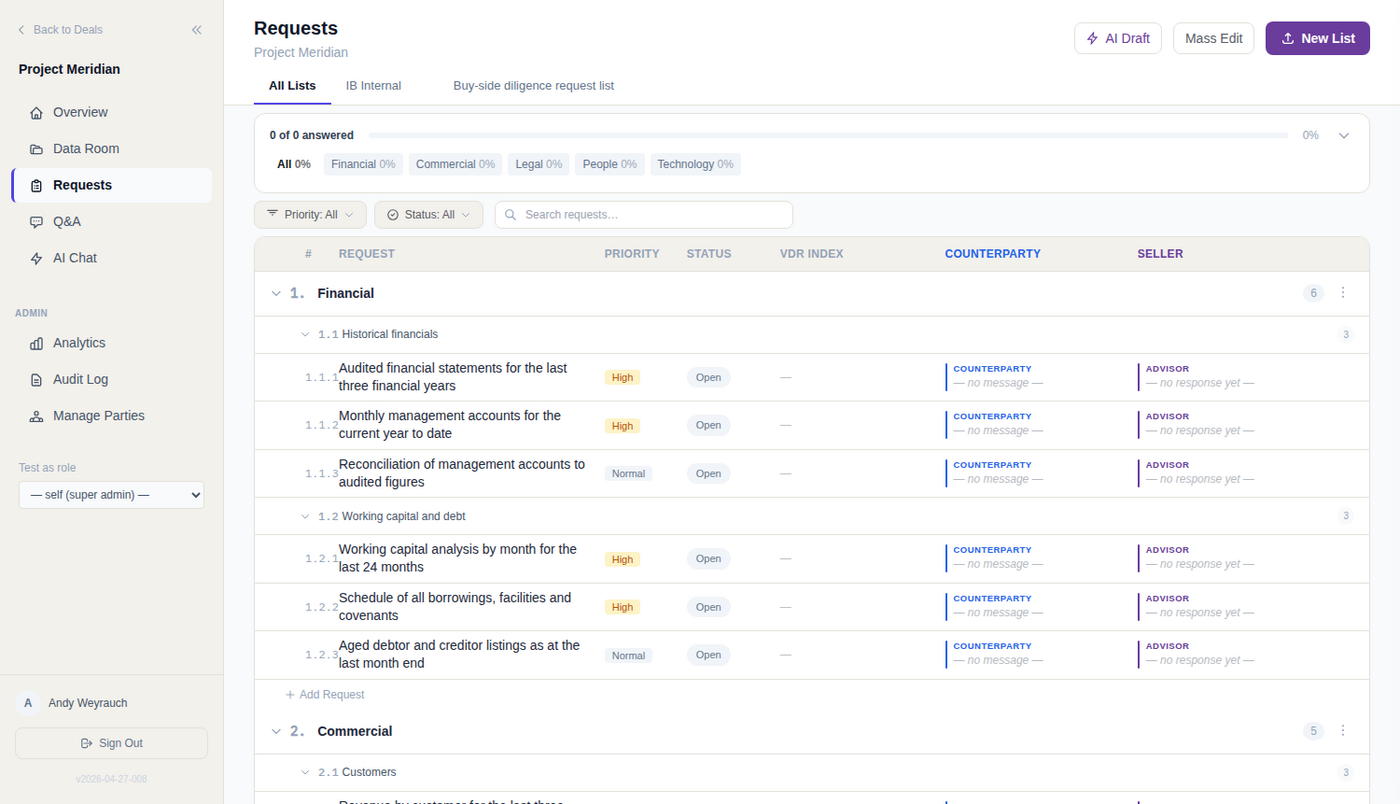
The difference
In an ordinary room each bidder’s Q&A is its own island, and your team writes the same paragraph as many times as it is asked. CogniVault treats a repeated question as a routing problem, not a writing problem: one reviewed answer, released to everyone entitled to it.
Technical view How it works in detail, and where it stops
Answer once, reuse everywhere
Answer-once matching spots that a new due-diligence request repeats one you already answered, and on approval attaches the earlier answer's confirmed documents to it. Four bidders asking for the same schedule get one answer, released four times, off one review.
- Embedded on arrival. Each request gets a vector from its title, section and description.
- Scanned on demand. Scan one request or a whole list. Pairs above the similarity bar become pending links, best first. Already-linked pairs are skipped, so rescanning never stacks duplicates of duplicates.
- Reviewed by a person. Approve in full, approve in part with a written gap description (an empty one is rejected), or dismiss.
- Inherited on approval. Approve in full and every confirmed answer document copies across, confirmed. No retyping, no risk of a different file set going out.
- Disputable. Buyers can dispute a merge in writing and your team reviews it again. The objection and the decision both stay on the request.
- Hidden until reviewed. Pending links are invisible to buyers.
The draft is a written answer
Ask for a draft and you get prose addressed to the counterparty, not a list of search hits. Each draft says whether the material is available in full, in part or not at all, answers in a sentence or two, and names what is missing.
- Inline citations. Short spans of the answer link to the document behind them, carrying the verified quote as the highlight target so the reviewer is not left hunting a long file. Verified documents sit under the answer as source chips.
- Nothing posts on its own. The verified draft comes back to your deal team with its source documents attached to it as chips. Send it as the advisor response, edit it first, or throw it away. The other side sees it when a person decides they should.
Drafting runs one request at a time. The saving is in not writing that paragraph again.
Every quote is checked against the source
The model cannot write freely into the deal record. It emits a structured draft through a forced tool call, and the server verifies every citation before anything reaches a screen. A citation survives only if:
- the document id resolves inside the permitted set for that draft;
- the quote is found in that document's extracted text as a whitespace-normalised substring, with an alphanumeric-only fallback so extraction artifacts do not discard a real quote;
- the anchor span appears in the answer.
If the model claimed the documents answer the question and nothing survived, the answer is discarded and replaced with a line routing the item for manual review.
Surviving drafts are scanned for deal-sensitive language (reserve, floor or walk-away price, competing bids), money figures absent from every verified quote, and negation flips against a quote. Each raises a review banner rather than blocking release, so the reviewer knows what to check.
Grounded in what the reader may see
A counterparty-facing draft is grounded only in documents that counterparty may read, never in what the drafting banker can see.
- One permission path. Retrieval is filtered by the same per-folder permission check as the file tree, in one shared code path, before ranking.
- Intersection, not union. Scope enumerates every counterparty organisation that can see the request's parent list, then admits a folder only if all of them may read it.
- Ambiguity denies. If scope cannot be resolved with confidence, nothing is admitted, with no fallback to the drafting user's access.
- Org baseline holds. Organisation-level checks ignore per-user overrides, so one generous grant cannot widen what the model may quote.
- One deal, one database. Retrieval touches only that deal's file, so cross-deal retrieval is structurally impossible, not policy-enforced.
Where this stops
- Scans are triggered, not automatic. An unscanned list carries no dedup signal.
- The private question board is weaker. Grouping there is keyword matching on open thread titles, with no comparison against published answers.
- One vector per document, no chunking. A long agreement is represented mainly by its opening, so retrieval cannot point at a clause buried inside it.
- Enrichment is best-effort. If extraction or embedding fails, the file stays viewable but has no vector, leaving it out of matching, dedup and chat until reprocessed.
- Scale has a ceiling. Every vector in the deal is scored on every query: comfortable at hundreds of documents, not a design for tens of thousands.
- Prompt guardrails are mitigation. The real boundaries are the per-deal database, the folder check before retrieval, and the quote verification above. Past those, the design assumes a person reads the draft.
See security for permissions and audit.
See it on your own deal.
General information, not legal, tax or financial advice. For how CogniVault handles security and access, see Security.