Product spotlight
Verified AI answer drafting
By the CogniSuite team
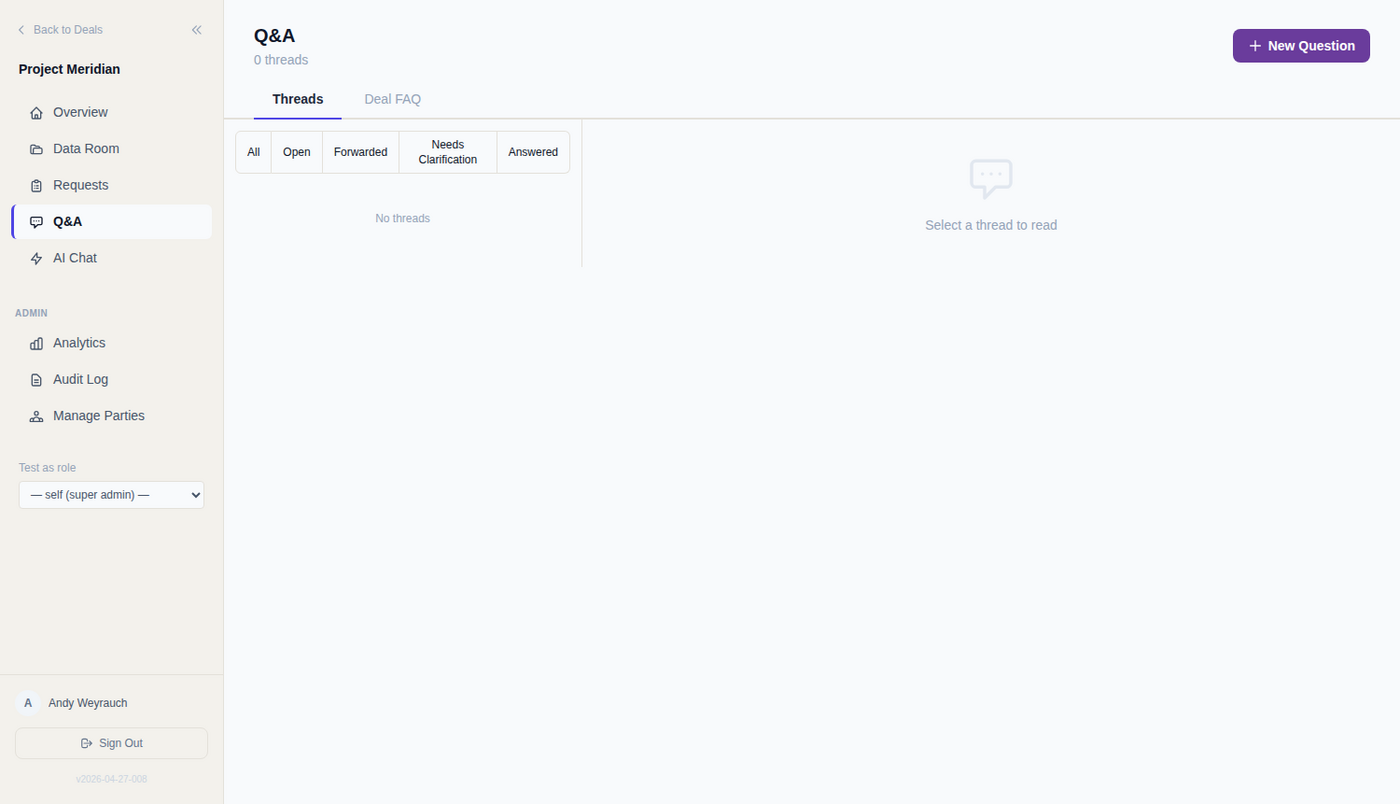
Now live in CogniVault: AI answers where every claim carries its evidence. Click a linked phrase in a drafted answer and the source document opens with the quote highlighted. Telling a model to cite its sources is an instruction. CogniVault makes it a check the server enforces before your reviewer reads a word.
What you get
- Claims linked to passages, not just files. Each verified quote becomes a link that opens the document at the exact place the words appear.
- Failed citations are dropped. The claim they backed loses its link and the draft carries a flag, so a reviewer sees exactly where the evidence thinned out.
- No evidence, no answer. If none of a draft’s citations survive checking, the answer is thrown away and the item is routed to a person.
- One gate for every surface. The Q&A board and the request list share one drafting and verification path, so the rules cannot drift apart.
The difference
Citation-shaped text is easy to generate. Damien Charlotin’s AI Hallucination Cases database had passed 1,600 tracked court decisions by July 2026, and Stanford RegLab found retrieval-backed legal tools still hallucinating on 17% to 33% of queries. That is why CogniVault confirms the quoted words exist in the cited file, server-side, before the draft renders. Reviewing becomes a judgement call on a quote in front of you, not a hunt for whether it exists.
Technical view How it works in detail, and where it stops
What verified drafting does
CogniVault drafts the answer to a diligence question, and every claim whose citation the server could find in the real file is linked to that passage. Click a linked phrase to open the document with the quote as the highlight target. A citation that fails a check is dropped, so the claim it supported loses its link and the draft carries a flag telling the reviewer where to look.
What matters on a live deal is the failure case: if none of a draft's citations survive checking, the answer is thrown away and the item is routed to manual review.
- Two surfaces, one code path. The Q&A board and request threads share one generation and verification function, so the gates cannot drift apart.
- Drafts go to advisory roles only. Nothing reaches the other side until a person sends it.
Why "cite your sources" fails
Telling a model to cite is an instruction, not a check. The citation comes from the same process that produced the claim, and nothing confirms the quoted words exist in the cited file.
The courts have receipts. Two attorneys and their firm were sanctioned $5,000 on 22 June 2023 over a brief citing six judicial decisions that did not exist (Mata v. Avianca). Damien Charlotin's AI Hallucination Cases database had passed 1,600 tracked decisions by July 2026.
Retrieval alone does not fix it. Stanford RegLab's Hallucination-Free? found hallucination rates of 17% to 33% of queries in retrieval-backed legal research tools, against 43% for GPT-4, many of them real citations attached to propositions the source did not support. In diligence such an answer can underpin a rep or a price adjustment, and its citation makes a reviewer less likely to check.
The three gates
The model does not write prose. It emits a structured draft through a forced tool call with a fixed schema: availability, answer, what is missing, and citations carrying a quote, a document id and an anchor. The app verifies it server-side before a character renders.
- Permission gate. The document id must resolve inside the set actually passed to the model: exact id, then one-based index, then exact title. A citation outside the permitted set cannot survive.
- Faithfulness gate. The quote must appear in that document's extracted text as a substring after whitespace normalisation, with an alphanumeric-only fallback so extraction artefacts do not discard it.
- Anchor gate. The span the quote supports must occur in the answer text, so a citation supporting nothing the reader sees is dropped.
- Fail-closed rule. Answer claimed available, zero citations surviving: the answer is replaced with the manual-review line and downgraded.
Survivors get scans that flag rather than block: MNPI terms such as walk-away price or "bidder X"; money figures absent from the verified quotes, canonicalised so $45.2M and 45.2 million compare equal; a quote that negates where the answer does not. Each verified anchor becomes a viewer link with the quote as highlight target.
What the model may see
Counterparty-facing drafts are grounded in what the other side may read, not what the advisor may read: retrieval is filtered by the same per-folder permissions as the file tree, in one shared code path, before a document is admitted.
- Request threads. The app enumerates every counterparty organisation that can see the parent request list and admits a folder only if all may read it. Intersection, not union.
- Ambiguity denies. If the owning organisation cannot be resolved, retrieval is denied rather than falling back to advisor access.
- Q&A threads. Grounding is scoped to the thread creator's access, and admits nothing unless they resolve to a buy-side role.
- Overrides cannot widen it. Organisation-level checks ignore per-user grants. More on the security page.
Where it stops
- A verified quote is not a correct reading. Verification proves the words exist, not that they mean what the answer says. A sentence can be lifted from a context that qualifies it, and the anchor link is there to check.
- The figure check is intra-answer. Nothing reconciles a figure in one document against a conflicting one in another.
- No OCR. A scanned PDF with no text layer gives a quote nothing to match, so it cannot be cited.
- One vector per document. A clause deep in a long agreement may not be retrieved, and verification cannot rescue what retrieval never surfaced. A Q&A draft searches on the thread title alone, so grounding is only as good as that title.
- Risk flags are heuristics. They direct attention, they do not certify an answer.
What changes for review
Reviewing an unverified AI answer means redoing the work: find the source, confirm the wording. Reviewing a verified draft means checking judgement: is the quote read correctly, should this be disclosed. The first takes as long as answering from scratch. The second holds across a few hundred items.
See it on your own deal.
General information, not legal, tax or financial advice. For how CogniVault handles security and access, see Security.