News
Court sanctions for unverified AI output, and what they imply for AI in a deal room
By the CogniSuite team
What the sanctions decisions punished
Courts are not punishing the use of AI. They are punishing citations nobody checked against the source. Norton Rose Fulbright's survey AI in litigation: Update on Gen AI sanctions in 2026 collects the 2026 record:
- Whiting v. City of Athens (6th Cir., 13 March). Two dozen-plus fabricated citations. Fees, double costs, $15,000 each against two attorneys, disciplinary referral.
- Gamez v. County of Fresno (E.D. Cal., 9 April). Nonexistent authorities, fabricated quotations, no sanction at all.
- NY Appellate Division, Second Department. Minnesota Lawyer, 2 July 2026: $10,500 in sanctions, $8,000 on the attorney and $2,500 on the firm.
Outcomes vary for near-identical conduct. Nothing looked wrong on the page, and no penalty turned on intent.
Courts now require signed verification
Two Florida circuits made verification a filing requirement. The Florida Bar reported Administrative Order No. 26-04 (11th Judicial Circuit, 15 January 2026) and Administrative Order 2026-03-Gen (17th, 26 January 2026).
- 11th Circuit. Counsel certifies that "all factual assertions, legal authority, and citations have been independently reviewed and verified for accuracy."
- 17th Circuit. The signer "has independently verified the accuracy of every citation to the law and /or the record, and the accuracy of any language drafted by generative artificial intelligence."
The duty attaches per citation; a disclosure line at the top does not discharge it.
Published counts run low. Norton Rose Fulbright cites a public database of over 1,148 documented lawyer hallucinations; the maintainer's FAQ calls it "necessarily an undercount", since entries are added only where a court identified the fabrication.
Why this reaches a deal room
No court sanctions a wrong answer in diligence, so the bill arrives later. Diligence responses feed the disclosure schedules that qualify the reps and warranties in the purchase agreement. An answer overstating a contract can support an indemnity claim or an earn-out dispute after closing, and the diligence record is discoverable. Same failure mode as the sanctioned briefs.
How CogniVault verifies AI answers
Every citation is checked on the server before anyone reads the draft. The model returns a structured object through a forced tool call, not free prose: a verdict on availability, the answer, what is missing, and citations carrying a verbatim quote, a document id, and the anchor phrase that quote supports. The app gates each citation.
- Permission. The cited document must sit in the set the receiving side may read. Ids that do not resolve are dropped.
- Faithfulness. The quote must occur in the document's extracted text as a whitespace-normalized substring, with an alphanumeric-only fallback for PDF and spreadsheet artifacts.
- Anchor. The anchor phrase must occur in the answer, so a citation cannot be pinned to a claim the answer never makes.
Claim availability with no citation surviving, and the answer is discarded, replaced with a routed-for-manual-review message, and flagged. Surviving drafts get scanned for material non-public information language, money figures absent from every verified quote, and negation flips, each raising a reviewer flag rather than blocking.
Two structural points:
- Counterparty-scoped grounding. A counterparty-facing draft is grounded only in the intersection of what every counterparty organization that can see the request list may read, and denies rather than widens when that scope will not resolve. See the access model.
- Per-deal isolation. Each deal is a separate database, so a query cannot reach another deal's material.
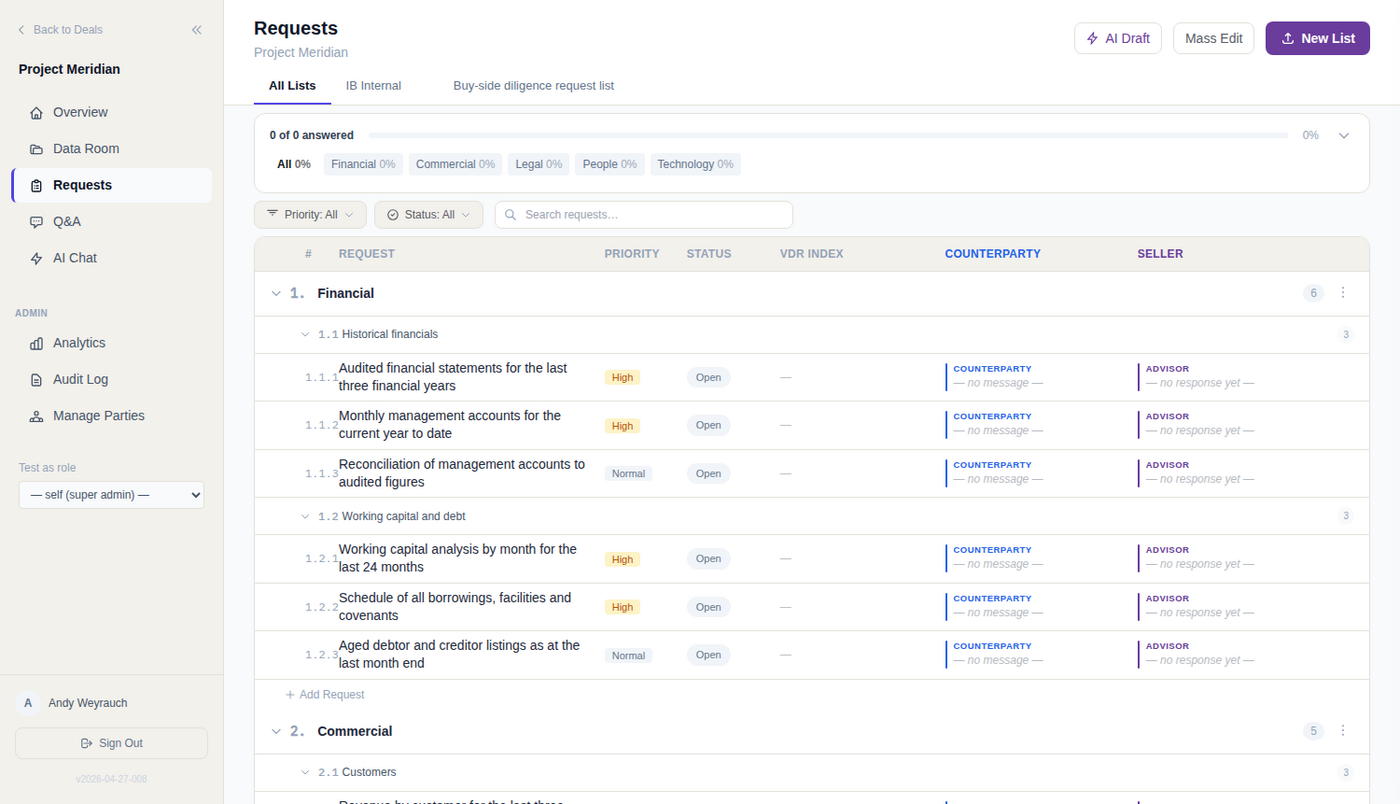
No draft sends itself. It goes back to the deal team for a person to decide.
What verification does not prove
Verification shows a sentence exists in a document the reader may see. It does not show the document is accurate, or that it is the one you should be relying on. Cite a superseded draft and every check still passes.
Other limits:
- Chat is weaker than drafting. The quote check runs on the counterparty-facing draft path. Room chat is told to cite each claim as a titled link to the source, but that is a prompt rule, not a server check.
- No passage-level retrieval. One truncated vector per document, so a clause buried deep in a long agreement may not surface.
- Failed extraction means invisible. A scanned PDF with no text layer is stored and viewable but carries no embedding, so it stays out of AI retrieval, unflagged, until the deal team re-runs enrichment.
- Injection defenses are prompt-level. The enforced boundaries are the per-deal database, the folder permission check before retrieval, and the quote verification above.
The test to apply
For each factual claim an AI feature produces, can a reviewer reach the exact supporting text, inside the document, in one step, without retyping the claim into a search box? If not, the verification work still falls to whoever signs.
General information, not legal, tax or financial advice. For how CogniVault handles security and access, see Security. To see it on a live deal, book a walkthrough.